How to use public EV chargers in the UK
Some links in this guide are affiliate links, including Amazon links. If you buy through them we may earn a commission, at no extra cost to you. As an Amazon Associate, we earn from qualifying purchases. More about how we're funded.
Using a public charger for the first time can feel daunting: different networks, apps, cards and connectors, and prices that vary a lot. In practice it's become much simpler, and most chargers now let you just tap a bank card. This guide explains the types of public charger, how to pay, what it costs and how to make it easy.
Quick answer
- Find a charger with an app such as Zapmap, your car's navigation, or the network's own app, and check it's working and free.
- Rapid chargers have a cable attached. Slower chargers usually need your own Type 2 cable.
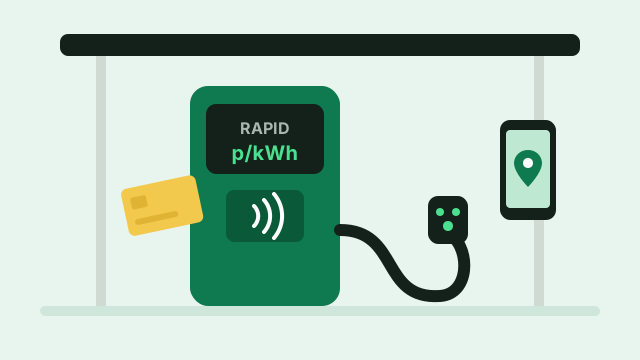
- Pay by contactless on rapid chargers and newer fast chargers, or use the network's app or a charging card.
- Public charging costs much more than home charging: on average around 54p per kWh on slower chargers and around 80p per kWh on rapid chargers, compared with under 10p on an off-peak home EV tariff.
- Move on when you're done, as many networks charge overstay fees.
The types of public charger
| Type | Typical power | Where you'll find them | Cable |
|---|---|---|---|
| Slow (lamp post and on-street) | 3kW to 7kW | Residential streets | Bring your own Type 2 |
| Fast | 7kW to 22kW | Car parks, supermarkets, hotels, workplaces | Usually bring your own Type 2 |
| Rapid | 50kW to 99kW | Service stations, retail parks, hubs | Attached (CCS, sometimes CHAdeMO) |
| Ultra-rapid | 100kW and above | Motorway services, charging hubs | Attached (CCS) |
How fast your car actually charges depends on the car as well as the charger. A car that accepts 7kW AC will charge at 7kW even on a 22kW post, and a car with a 100kW rapid charging limit won't go faster on a 350kW charger. Your car's handbook lists its maximum AC and DC charging speeds.
Which connector do I need?
- Type 2 is the standard socket on slow and fast chargers in the UK. Most need your own Type 2 cable. See our charging cables guide to choose one.
- CCS (Combined Charging System) is the standard rapid charging connector on almost all new EVs. The cable is always attached to the charger.
- CHAdeMO is an older rapid connector used by some cars such as earlier Nissan Leafs. It's becoming less common, so CHAdeMO drivers should check availability before setting off.
How to pay
Under the Public Charge Point Regulations 2023, all public rapid chargers (50kW and above) and new public chargers of 8kW and above must accept contactless payment. Prices must be shown in pence per kWh before you start, and operators must also let you pay through at least one roaming app or card, so you don't need an account with every network.
Your options are usually:
- Contactless bank card or phone: the simplest option. Some chargers place a temporary hold on your card, which is released once the final cost is known.
- The network's own app: often needed on older or slower chargers, and sometimes gives cheaper rates or a membership discount.
- A roaming app or card: one account that works across many networks, which is handy if you charge on lots of different networks.
How much does public charging cost?
According to Zapmap's Price Index, the weighted average pay-as-you-go price in October 2026 was around 54p per kWh on slow and fast chargers and around 82p per kWh on rapid and ultra-rapid chargers. Prices on the biggest rapid networks varied widely, from under 60p to over 90p per kWh.
Part of the gap with home charging is VAT: public charging carries 20% VAT, while home electricity has 5%. Here's what adding about 30kWh (roughly 100 miles in a typical EV) costs in different places:
| Where you charge | Price per kWh | Cost for about 30kWh |
|---|---|---|
| Home, on an off-peak EV tariff | around 7p | about £2 |
| Home, at the price cap rate | 26.32p | about £8 |
| Average public slow or fast charger | 54p | about £16 |
| Average public rapid or ultra-rapid charger | 82p | about £25 |
If you can, do most of your charging at home and use public rapid chargers mainly on long journeys. Our EV tariffs guide explains how to get the cheapest home rates. If you don't have a driveway, see our guide to charging without a driveway.
Step by step: using a rapid charger
- Check the charger in an app before you arrive, to see if it's working and available, and what it costs.
- Precondition the battery if your car can, by setting the charger as the destination in its navigation. A warm battery charges much faster, especially in winter.
- Park in the bay so the cable reaches your charging port comfortably.
- Choose the connector (usually CCS) on the screen, if asked.
- Tap your card or start the session in the app, then plug in. Some chargers want you to plug in first; follow the instructions on screen.
- Check that charging has started on the charger screen or in your car.
- Stop at around 80%. Rapid charging slows down a lot above this, so on a long trip it's usually quicker to stop more often.
- End the session, unplug and move on, so the next driver can use it.
Step by step: using a slow or fast charger
- Get your Type 2 cable out and plug it into the charger and your car.
- Start the session by contactless, the network's app or a roaming card, as shown on the charger.
- Check the charging light on the charger or your car to confirm it's working.
- Return in good time. Many car park and on-street chargers have time limits or overstay fees.
Tips to make public charging easier
- Keep a Type 2 cable in the car, in a bag so it's easy to get out (see cable bags on Amazon).
- Have a backup charger in mind on long trips, in case your first choice is busy or out of action.
- Consider a membership on the rapid network you use most, which can lower the price per kWh.
- Look for off-peak public rates: some networks are cheaper overnight.
- Keep a phone charger in the car, as you may need your phone to use apps.
- Report faults using the phone number on the charger or the app. Operators must provide a free 24-hour helpline.
Charging etiquette
- Only park in a charging bay while you're charging.
- Unplug and move as soon as you're finished, particularly at rapid chargers.
- On a busy rapid charger, charge to what you need rather than to 100%.
- Coil and hang up the charger's cable so it isn't driven over.
- Never unplug someone else's car unless the charger allows it and their session has clearly finished.
Frequently asked questions
Can I use any public charger with my car?
Almost all modern EVs can use any Type 2 charger and any CCS rapid charger. Older cars may use Type 1 (with a Type 1 to Type 2 cable) or CHAdeMO for rapid charging. Many Tesla Supercharger sites are now open to other EVs too, using the Tesla app.
Why does a charger show a higher price on my card than I used?
Some contactless chargers place a temporary pre-authorisation hold on your card. This is released after the session, and you're only charged for the energy you actually used.
Is it bad for the battery to use rapid chargers?
Occasional rapid charging is fine and is what the car is designed for. Manufacturers generally recommend slower AC charging for everyday use where possible, but the battery management system protects the battery either way.