EV charging cables explained: which one do you need?
Some links in this guide are affiliate links. If you buy through them we may earn a commission, at no extra cost to you. More about how we're funded.
Most electric cars come with at least one charging cable, but it isn't always the one you need. You might want a longer cable for the driveway, a spare to keep in the boot, or a cable for public chargers that don't have one attached. Cables aren't cheap, and the jargon (Type 2, 32A, three-phase, Mode 3) doesn't help.
This guide explains what each term means and how to pick the right cable for your car, in five quick questions.
Quick answer
For most UK drivers with a modern EV, the right cable is a Type 2 to Type 2, 32A cable, around 5m to 7.5m long. Single-phase is fine if you only charge at home; choose three-phase if your car supports it and you use public or workplace chargers. If your car is older and has a Type 1 socket, you'll need a Type 1 to Type 2 cable instead.
Which cables do you actually need?
- Home charger with a tethered cable: you don't need a separate cable at home. A Type 2 cable in the boot is still useful for public chargers.
- Home charger with a socket (untethered): you need your own Type 2 cable for home and for most public chargers.
- Public rapid chargers: these always have their own cable attached, so you never need to bring one.
- Slower public chargers (lamp posts, supermarkets, car parks): most have a socket, so you need to bring your own Type 2 cable.
Question 1: Type 1 or Type 2?
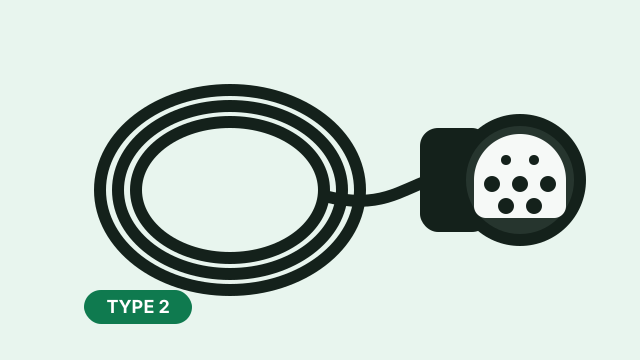
This is about the socket on your car. Type 2 is the European standard and is used by almost every EV and plug-in hybrid sold new in the UK. Type 1 is found on some older cars, such as early Nissan Leafs and older Mitsubishi Outlander plug-in hybrids.
The other end of the cable, the end that plugs into the charger, is Type 2 on almost all UK chargers. So you'll want either a Type 2 to Type 2 cable or, for an older Type 1 car, a Type 1 to Type 2 cable. Check your car's charging flap or handbook if you're unsure.
Question 2: 16A or 32A?
The amp rating is the maximum current the cable can carry. On a normal single-phase supply:
- a 16A cable charges at up to about 3.7kW
- a 32A cable charges at up to about 7.4kW, roughly twice as fast
A 32A cable works perfectly well with a car or charger that only supports 16A, as the car and charger agree the speed between them. A 16A cable, though, will slow down a car that could charge faster. Unless you only drive a plug-in hybrid with a small battery, buy 32A. It costs a little more but won't hold back your next car.
Question 3: single-phase or three-phase?
Nearly all UK homes have a single-phase supply, which tops out at about 7.4kW. Many workplace and public chargers are three-phase, which can deliver 11kW or 22kW, but only if your car supports three-phase AC charging and you're using a three-phase cable.
- Only ever charge at home? A single-phase 32A cable is all you need.
- Use public or workplace chargers, and your car supports 11kW or 22kW AC charging? A three-phase 32A cable lets you use the faster speed. It also works on single-phase chargers, so it covers everything.
Three-phase cables are thicker, heavier and usually more expensive, so there's no point buying one if your car can't use it. Your car's maximum AC charging speed is in the handbook or on the manufacturer's website.
Question 4: what length?
Cables commonly come in 5m, 7.5m and 10m lengths, with longer ones available to order.
- 5m suits most public chargers and driveways where you park close to the charger.
- 7.5m is a good all-rounder, giving you room to reach awkward public bays or a charging port on the far side of the car.
- 10m or more is for long driveways or garages, but it's heavier, bulkier to store and more expensive.
Think about where your car's charging port is (front, rear, left or right) and how you usually park. A cable that's too short is useless; one that's far too long is a trip hazard and a pain to coil up in the rain.
Question 5: what else should you check?
- Mode 3: this is the standard for cables that plug into a charge point. A Type 2 to Type 2 cable should be Mode 3.
- Weather rating: look for an IP rating such as IP54 or IP65. The higher the numbers, the better it resists dust and water.
- Warranty and build quality: buy from an established UK seller and look for a decent warranty. Very cheap cables from unknown marketplace sellers are best avoided: this is high-current equipment.
- A storage bag: it keeps the boot clean and stops the plugs getting damaged.
What about 3-pin "granny" cables?
A 3-pin cable plugs into a normal household socket and has a control box built into the lead. It's handy as a backup when visiting friends or family, but it's slow, adding only a few miles of range per hour. A standard socket also isn't designed to supply that much power for many hours every night. For regular home charging, a dedicated home charger is faster and safer. See our guide to the best home EV chargers.
Common examples
| Your situation | Cable to buy |
|---|---|
| Modern EV, charges at home on an untethered charger and occasionally in public | Type 2 to Type 2, 32A, single-phase, 5m to 7.5m |
| Modern EV that supports 11kW or 22kW AC, uses workplace or public chargers | Type 2 to Type 2, 32A, three-phase, 5m to 7.5m |
| Plug-in hybrid that charges at 3.7kW | Type 2 to Type 2, 16A or 32A (32A future-proofs it) |
| Older car with a Type 1 socket | Type 1 to Type 2, matching your car's maximum current |
Where to buy
Specialist EV retailers such as EV King stock Type 2 and Type 1 cables in a range of lengths and ratings, and can advise on the right one for your car. Car parts retailers and some car manufacturers also sell cables.
Browse charging cables at EV KingFrequently asked questions
Will a faster cable charge my car faster?
Only up to your car's limit. Charging speed is set by whichever is lowest: the charger, the cable or the car. A 22kW cable won't make a car that accepts 7kW charge any faster, but it won't do any harm either.
Can I use an extension lead with a charging cable?
No. Manufacturers and safety bodies advise against using domestic extension leads for EV charging, as they aren't designed for the sustained load. Buy a cable that's long enough instead.
Do I need a cable for rapid chargers?
No. Rapid and ultra-rapid chargers always have their own cables attached.
How do I look after my cable?
Keep the plugs clean and dry, don't drive over the cable, and coil it loosely rather than wrapping it tightly. If the cable or plugs are damaged, stop using it and replace it.