How to charge an electric car without a driveway
Some links in this guide are affiliate links. If you buy through them we may earn a commission, at no extra cost to you. More about how we're funded.
Millions of people in the UK live in terraced houses or flats and park on the street. Not having a driveway used to be the biggest obstacle to going electric, but it's getting much easier. Changes to planning rules in England this autumn, a government grant and a fast-growing network of on-street chargers mean there are now several realistic options.
This guide runs through each one, what it costs, and how to keep your charging bills down.
Quick answer
- Cross-pavement charging lets you charge from your own home supply at cheap overnight rates. You'll need council approval, but in England you no longer need planning permission, and a grant of up to £500 is available.
- Lamp post and on-street chargers are the easiest option if there's one near you, especially overnight when some networks charge less.
- Workplace, supermarket and other destination chargers let you top up while you're parked anyway.
- Rapid chargers are the quickest but most expensive, so they're best kept for long journeys.
Option 1: cross-pavement charging from your home
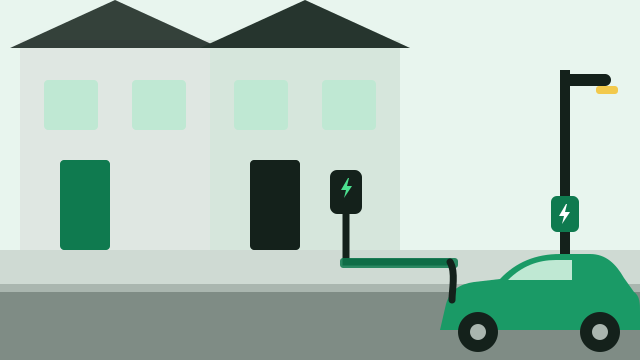
A cross-pavement solution is a permanent channel set into the pavement outside your house. You fit a normal home charger on your wall, and when you want to charge, you lay the cable into the channel so it runs safely under or level with the pavement to your car. Leading products include Kerbo Charge, Gul-e and Pavecross, and councils often approve specific ones.
It's the closest thing to having a driveway, because you charge from your own electricity supply. That means you can use a cheap overnight EV tariff, which is far cheaper than any public charger.
What you need
- Council approval. Your council has to approve the channel, and not every council offers it yet. Check your council's website for "cross-pavement" or "EV charging channel". Some run their own schemes, and a few offer extra subsidies.
- A suitable spot. You'll need to be able to park reasonably close to your house most of the time.
- A home charger and installer. See our home charger guide and installation guide.
Planning permission and grants
Since 21 October 2026, households in England no longer need planning permission for a cross-pavement channel and the charger that goes with it, although the council still has to approve the channel. The government's chargepoint grant for households with on-street parking gives up to £500 towards the charger, as long as you're installing a permanent cross-pavement solution alongside it. The grant is currently due to run until 31 March 2027, and your installer claims it for you.
Rules differ in Scotland, Wales and Northern Ireland, so check with your council there.
What it costs
In-pavement channels typically cost somewhere between £600 and £1,400 to install, on top of the charger and its installation. The grant reduces the total. Some charger brands now sell a package with a cross-pavement partner. Pod, for example, offers its charger with Kerbo Charge's channel and handles the process with you.
See Pod's cross-pavement packageOption 2: lamp post and on-street chargers
Many councils have added chargers to lamp posts and street bollards in residential roads. The two biggest networks are Shell Recharge ubitricity and char.gy. You plug in with your own Type 2 cable (see our charging cables guide), charge slowly overnight, and pay by app or card.
These chargers are slow, usually a few kilowatts, but that's fine for overnight charging. Some networks are cheaper at night:
- ubitricity has charged 44p per kWh from midnight to 7am, 55p at standard times and 66p at peak times (4pm to 8pm) since April 2026.
- char.gy charges 39p per kWh at night (midnight to 7am) and 59p during the day.
If there's no on-street charger near you, it's worth asking your council. Many are expanding their networks with government funding and take residents' requests into account.
Option 3: charge while you're parked elsewhere
- At work. If your employer has chargers, this can be one of the cheapest options, and sometimes it's free. If not, it's worth asking: government grants are available to help businesses install them.
- Supermarkets, gyms, leisure centres and car parks. Many have chargers, so a weekly shop or a session at the gym can add a useful top-up.
- Public car parks near home. Some council car parks offer overnight charging, sometimes with reduced parking fees.
Option 4: rapid charging hubs
Rapid and ultra-rapid chargers can add a lot of range in 20 to 40 minutes, which makes them invaluable on long journeys. Using them for all your charging is convenient but expensive. If you go this way, look for networks with membership plans that reduce the price per kWh, and use an app such as Zapmap to compare prices nearby.
How the costs compare
Here's an example for a driver doing 8,000 miles a year in a car averaging 3.5 miles per kWh, which needs about 2,300 kWh of charging a year:
| Where you charge | Price per kWh | Approximate yearly cost |
|---|---|---|
| Home via cross-pavement, on an EV tariff | around 7p off-peak | about £160 |
| char.gy lamp post, at night | 39p | about £890 |
| ubitricity lamp post, at night | 44p | about £1,010 |
| Average public slow and fast charger | 54p | about £1,230 |
| Average public rapid or ultra-rapid charger | 82p | about £1,870 |
The gap is large: over a year, charging at home via a cross-pavement channel could save around £700 or more compared with even the cheapest lamp post rate. That's why cross-pavement charging, where your council allows it, can pay for itself in around two to three years.
Tips to keep public charging costs down
- Charge overnight on networks with cheaper night rates.
- Use a charging app such as Zapmap to find and compare chargers and see live availability.
- Consider memberships on the rapid networks you use most, which can lower the price per kWh.
- Top up while you're parked anyway, at work, the supermarket or the gym, rather than making special trips.
- Keep a Type 2 cable in the car for chargers without a tethered cable.
Frequently asked questions
Can I run a cable across the pavement if I'm careful?
No. Trailing a cable across a public pavement creates a trip hazard and could make you liable if someone is injured. Use an approved cross-pavement solution instead.
What if I park on the street but not always outside my house?
Cross-pavement charging only works if you can usually park near your home. If you can't, on-street, workplace or destination charging is likely to be more practical.
I live in a flat with a car park. Is that different?
Yes. If you have private off-street parking at a flat, you may be able to install a charger with your freeholder's or landlord's permission, and a separate grant of up to £500 is available for flat owners and renters. See our home charger guide.